
Nitrogen: Bin-Buster or Buzzword?
A New Perspective on One of Farming’s Most Costly Inputs.
Nitrogen is one of the biggest drivers of crop yield. It’s also one of the biggest line items in the input budget. When managed effectively, nitrogen helps put bushels in the bin. When it’s not, it can leave the field through water or the air, taking dollars with it.
Each season, we collect an assortment of data from the fields enrolled in our programs and how they’re managed. This information is used to calculate environmental outcomes, which validate practices for our funding partners. We’re also able to analyze the data and make recommendations to help our farmers optimize their operations.
Through collecting this data over the past five years, we’ve discovered a key management practice that is costing farmers much more than it needs to: nitrogen application.
The Traditional Approach
Nitrogen is often considered a universal fix for increasing crop performance. Want more yields? Apply more nitrogen.
Our data shows otherwise. We see many farmers using an unbalanced ratio of nitrogen to yield—applying more than 220 pounds of nitrogen and yielding less than 200 bushels of corn in return.
So, if nitrogen application is increasing, why aren’t yields? This is usually because nitrogen is being used to solve a problem it’s not able to fix.
While nitrogen is a critical nutrient for crop performance, there are many other factors that contribute just as much, if not more, to yields.
The Law of the Minimum
Liebig’s Law of the Minimum proves this theory. A crop’s yield potential is only as great as its scarcest nutrient. This means nitrogen is not always the yield-limiting factor. Rather, whatever nutrient is least available is the true yield-limiting factor.
As you can see in this barrel illustration, the water (or yield) can only reach as high as the shortest stave (or least-available nutrient). To increase the capacity, you must lengthen that stave. Then, the next shortest stave becomes the limiting factor.
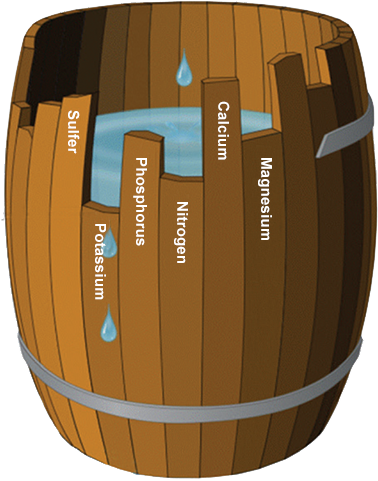
Figure 1. Liebig's law of the minimum illustrated using the barrel stave concept.
The Environmental Factor
Efficient nitrogen management also supports environmental sustainability. Any nitrogen that isn’t taken up by the crop has to go somewhere. In some cases, that means it moves with water or escapes into the air.
When nitrogen moves with water, it often shows up as nitrate in tile lines, ditches, streams and groundwater. Nitrogen can also be lost to the air as nitrous oxide. Under certain soil and weather conditions, nitrogen is converted to nitrous oxide, a greenhouse gas with a much stronger warming effect than carbon dioxide. Ammonia loss can also occur, especially when nitrogen is surface-applied and conditions aren’t ideal.
From a practical standpoint, these losses cost farmers, as nitrogen is paid for but never used by the crop. At the end of the day, nitrogen loss isn’t just an environmental issue. It’s an efficiency issue.
Reducing excess nitrogen applications means reducing these negative ripple effects—outcomes valued by SWOF’s corporate partners.
A New Path Forward
Nitrogen rates depend on a wide variety of factors, making it impossible to create a one-size-fits-all solution. Farmers can use tools like the Corn Nitrogen Rate Calculator or N-FACT to see specific recommendations for their location and crop rotation, and enrolled farmers can talk with their SWOF field representative to discuss their individual application rates and re-assess their management strategy.
By reducing nitrogen rates, farmers can reallocate those input dollars into tools like irrigation or drainage for water management or micronutrients for supplemental crop nutrition, or they can simply enjoy the savings of reduced inputs.
As with any management practice, it’s always beneficial to take a step back to assess the facts and evaluate the approach. In the end, farmers will either be validated in their existing strategy or uncover an opportunity to improve their efficiency with a new one.
Making the Most of Nitrogen Applications
Lower application rates don’t have to mean lower nutrient levels in your crop. Many SWOF farmers are already using management approaches that reduce nitrogen loss and make sure the nitrogen you are applying actually gets to your crop. Others are finding that small adjustments can make a difference.
Adjusting application rates based on realistic yield goals and field history is often the first place to look. In some cases, splitting applications or moving more nitrogen closer to when the crop needs it can improve uptake. Products like stabilizers or inhibitors can help reduce losses during wet or warm conditions. Cover crops can take up leftover nitrogen after harvest, keeping it from moving out of the field before the next crop. Placement also matters; banding or injecting nitrogen can reduce losses compared to surface applications. Biological products used with nitrogen rate reductions can be a good combination as well.
Reach out to your SWOF field representative to talk through nitrogen management on your farm and improve your nutrient efficiency this season.